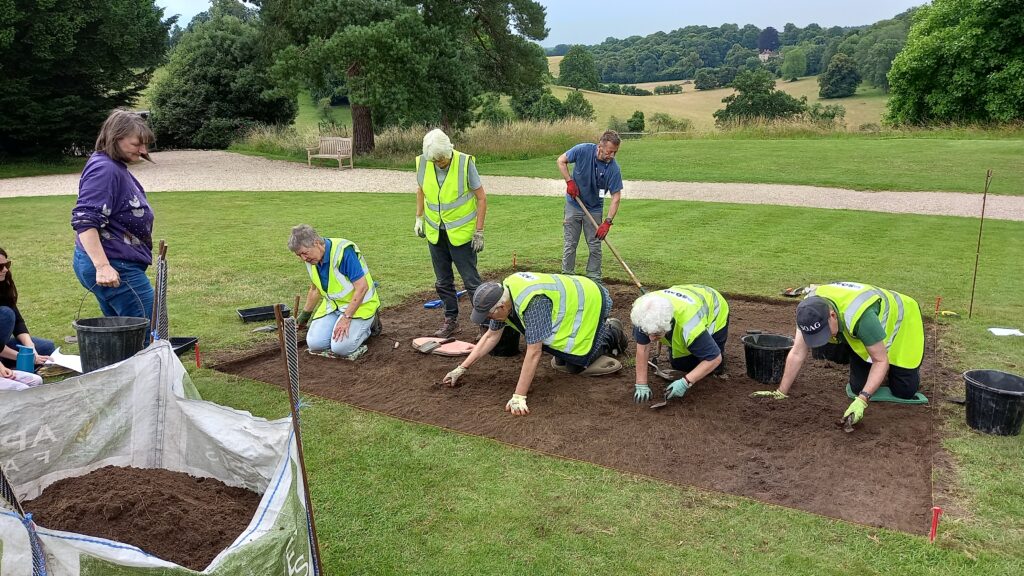
This summer, visitors to National Trust Greys Court will have the opportunity to witness archaeology in action as experts return to continue uncovering the site’s rich and layered history. The excavation, running from 19–27 July, is part of the Festival of Archaeology and invites the public to engage with the latest discoveries and techniques used to explore the past.
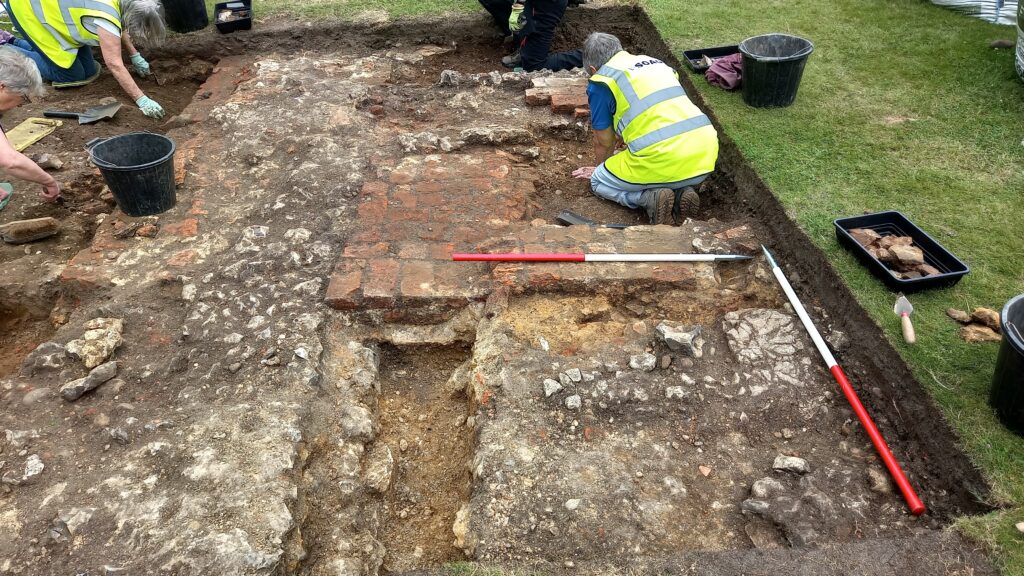
Building on last year’s findings, archaeologists from the National Trust and the South Oxfordshire Archaeology Group (SOAG) will investigate a new area of the Oval Lawn, seeking evidence of a historic inter-court range that may have once connected buildings on the west and east sides of the medieval courtyard. Last year’s excavation revealed part of a 16th-century courtyard wall and, even more remarkably, a section of a 13th- or 14th-century defensive ‘curtain’ wall.
These discoveries shed light on how the site evolved—from a fortified medieval manor to a more formal Tudor residence. The curtain wall, likely enclosing the entire property, served both defensive and symbolic purposes, reflecting the status of its aristocratic owners. Fragments of pottery, roof tile, brick, animal bone, shell, clay pipe, and iron nails spanning from the 15th to the 19th centuries were also uncovered. These finds offer glimpses into the lives of those who lived and worked at Greys Court—builders, servants and residents—revealing how the courtyard was used for both formal and practical purposes, such as stabling and workshops.
To guide their investigations this year, archaeologists have used geophysical survey techniques to allow researchers to detect buried features without disturbing the ground. Resistivity measures how easily electrical currents pass through the soil, revealing differences caused by features like walls or ditches. Magnetometry detects variations in the Earth’s magnetic field caused by the presence of buried materials, such as bricks or iron objects. These techniques help create subsurface maps to guide targeted excavations.
Adrian Cox, National Trust archaeologist, said: “This exciting new archaeological work at Greys Court is shedding new light on the history and development of this very special place, and we want to engage with as many visitors as possible during this summer’s excavation. Come along and see archaeology in action and hear about the latest discoveries.” I met Adrian at the Grey’s Court dig earlier this week. He explained that the reason why they picked the location was that it looked complicated on the preliminary scans undertaken of the lawn area to highlight possible walls and other structures under the ground.
This certainly proved to be the case when the earth was removed and an early brick culvert designed to take rainwater away from the house was intersected by a later stone wall, of a width that indicated a 2-storey building. He explained that it was thought the building linked guest quarters with the main house and was designed so that guests could come and go from their quarters without being at risk from the elements.
As we discussed often, there were later additions to the houses, as the landowners were keen to have the kudos of having been host to the royal retinue on one of their tours around the country. Adrian also pointed out the line of the wall in the trench lined up with where obviously a doorway was filled in on the first floor of the house.
My visit was also timely, in that whilst talking to Adrian, the diggers found a shard of unglazed pottery, and later a dress pin made from copper-alloy wire. One other interesting fact I learned from Adrian was that recycling happened even in the medieval period. Oysters were often on the menu, but their shells were not discarded.
They were kept to one side, ground up, and used in creating lime mortar. Lime mortar was especially useful in houses like Greys Court, as it has flint used in the construction. Flint should be set in lime mortar for the best results.
Visitors are encouraged to explore the site during the excavation period, speak with archaeologists, and learn about the evolving story of Greys Court. Festival of Archaeology runs at Greys Court from 19-27 July. No booking is required, and the event is included with standard admission. Families, history enthusiasts, and curious minds of all ages are welcome. Please feel free to check out Greys Court’s National Trust website.
Images (c) Adrian Cox from the 2024 dig